The record
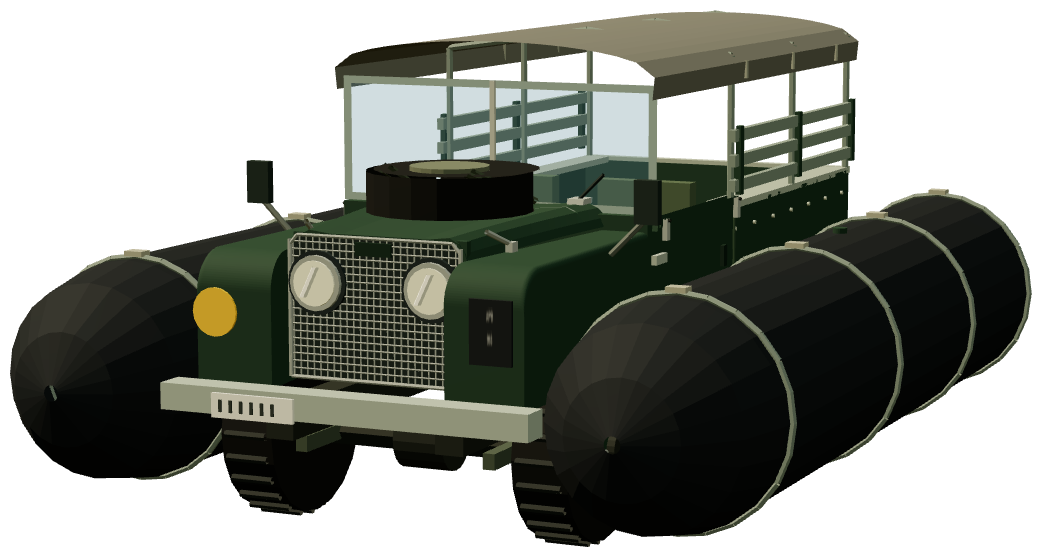
The APGP — Air Portable General Purpose — was a Rover answer to an early-1960s requirement for a general-purpose vehicle that could be flown anywhere and then swim ashore. The bodywork was kept deliberately low and the windscreen folded flat so that two vehicles could be stacked one on top of the other inside a transport aircraft, and the design was pitched as a multi-role platform: a radio station, a carrier for the Wombat 120 mm recoilless anti-tank gun, or a 110-volt power source for field tools. It was built to a one-ton military 109 specification with 24-volt electrics.
Underneath it was a long-wheelbase Series IIA with the standard 2,286 cc petrol four and four-speed gearbox, but with the rear body widened from just behind the front seats and fitted with longitudinal bench seats for up to ten men including the driver, folding down to make a flat cargo bed. There was no side canvas for the driver or passenger. It rode on 9.00×16 tyres with drop-shackle suspension and lowered gearing — the first military 109 to combine those features, anticipating the 1-Ton 109 of 1968–77 — though the steering was left standard, which gave the vehicle a famously large turning circle.
For the water the engine was waterproofed and deep-wading equipment fitted, including a breather pipe and a one-way valve in the exhaust. The chassis was filled with foam for buoyancy and a removable framework carried rubberised flotation bags that were inflated by exhaust gas. Propulsion afloat came from a small propeller on the rear propshaft, engaged and disengaged by a lever beside the gearbox; there was no water rudder, so steering depended on the front tyres. Several bag layouts were trialled, including rectangular bags front and rear as well as at the sides, before the side-bag arrangement settled as the final form.
Around 26 were built for troop trials in 1964, and the type was never taken into service. By the time an APGP had been prepared to enter the water any tactical advantage had been lost, and a single small-arms hit on a flotation bag was enough to sink one. Enthusiast accounts put the number built slightly lower, at about 23, and record persistent but unverified rumours of desert service, along with a claim that one example was fitted with a Rover gas turbine.
The surviving vehicle most often photographed is APB 963A, chassis 331000008A, in the Dunsfold Collection — the first vehicle Brian Bashall bought into what became the Collection, from a Ruddington military auction in 1968. It was made up from the best parts of two APGPs, the second going to another collector. Dunsfold swam it for the first time in 1998, during Land Rover's fiftieth-anniversary year, and it has since swum at many events. The APGP should not be confused with the OTAL (One Ton Amphibious Land Rover), a separate one-off prototype of 1965 built for the Australian Army with a six-cylinder engine and watertight aluminium body, which is also preserved at Dunsfold.