The record
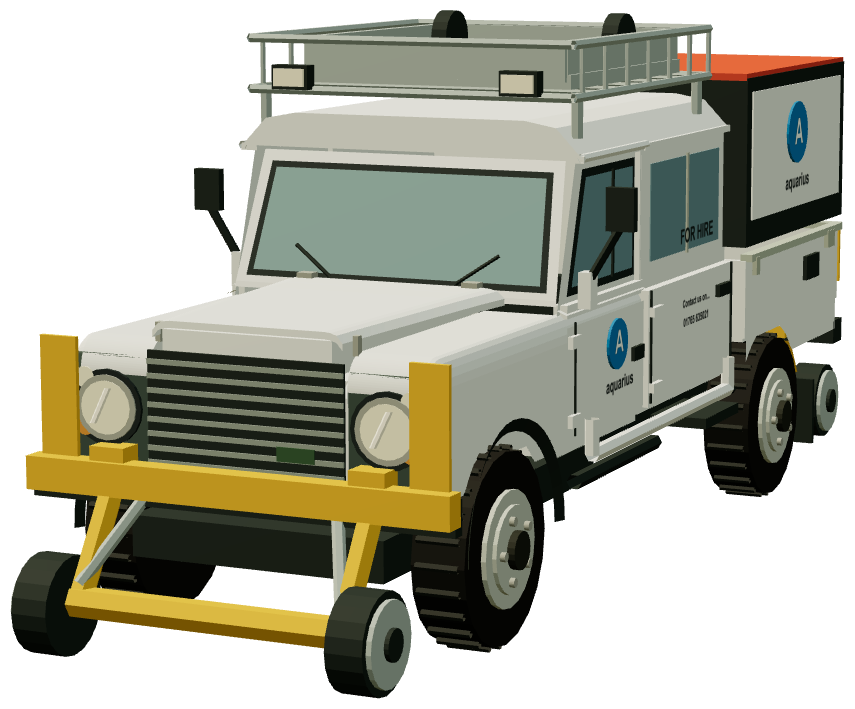
A road-rail vehicle drives to a railway access point on its tyres, lowers a set of flanged guide wheels onto the rails and then runs along the track on its road wheels, steered by the rail gear. Aquarius Railroad Technologies of Ripon has built them on Land Rovers since 1999, and the R2R 4×4 is the Defender form: a sub-3.5-tonne four-wheel-drive in Network Rail's class 9C, with compact electro-hydraulic rail gear actuated by push-button from the cab, carrying up to eleven people, 1,000 kg on road and 1,450 kg on rail. On rail it is limited to 20 mph on plain line, 5 mph over switches and crossings, 10 mph towing or propelling, and 15 mph in reverse with a clear view (otherwise 3). It can tow or propel up to three of Aquarius's 1,000 kg ultralight trailers, or the firm's Load Tray Extension, a 550 kg tray that adds payload behind. Network Rail uses them where access points are few — an off-track supervisor on the West Highland Line is quoted to that effect — as do contractors and metro lines.
The documented vehicle is YE64 WNR, a Defender 130 double cab registered in late 2014, and therefore a 2.2-litre Puma car. Its RSSB Engineering Conformance Certificate, 21/0087/23, issued by SNC-Lavalin Rail & Transit Verification on 8 February 2023 and valid to 21 September 2027, records vehicle number 99709 976106-3, a tare weight of 2,450 kg and a gross weight on rail of 3,900 kg, and lists the limitations: possessions only, low-ride mode, no on-tracking on cants over 150 mm or gradients steeper than 1 in 25, and no live conductor rails. It was first certified in 2020, and the class's first-of-type, 99709 976095-8, in 2017. The certificate gives the chassis number in two forms that differ in their last digits, SALLDKVP7FA461968 and SALLDKVP7FA461926 — a clerical discrepancy in the source, recorded here as found.
Aquarius publishes no fleet total.