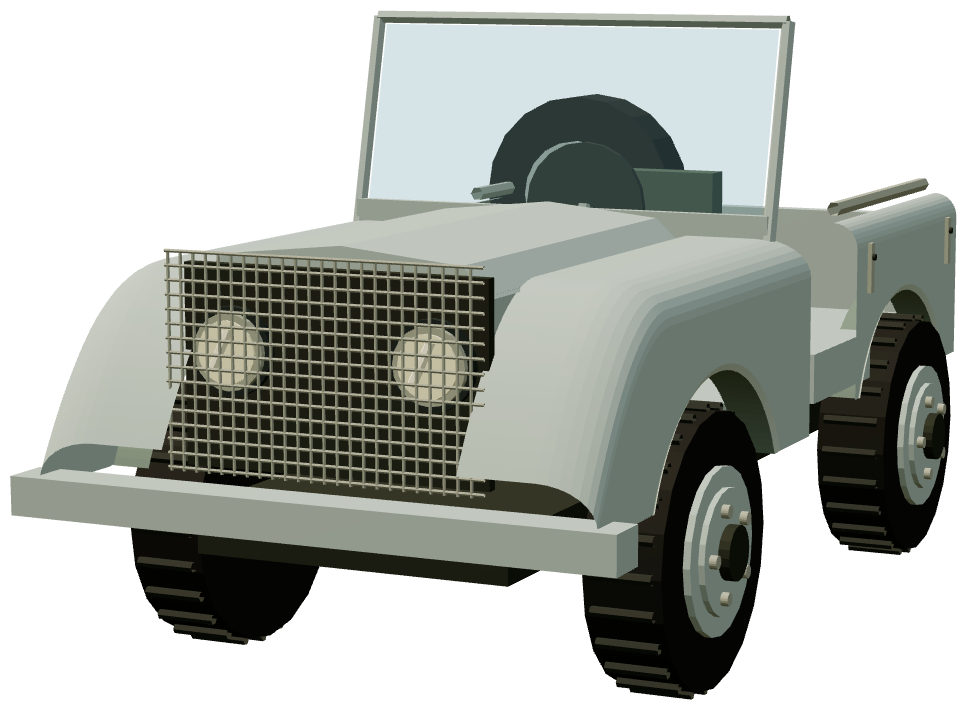
The record
In 1947 Rover's engineering director Maurice Wilks, who ran a war-surplus Willys Jeep on his Anglesey farm, proposed a light agricultural 4x4 to earn Rover dollar-export income while its saloon business recovered. The prototype his team assembled in autumn 1947 (September per most accounts; October 1947 per historian James Taylor's study of the works photographer's negatives) was a hybrid: an 80-inch Jeep chassis, axles and transfer gearing carrying a Rover 1.6-litre four-cylinder engine and the four-speed gearbox from the Rover P3 saloon. Its signature feature was a tractor-style central steering position, chosen because it felt familiar to farmers, freed space either side of the driver, and promised to eliminate separate left- and right-hand-drive production.
In practice the centre-steer layout proved awkward, with poor legroom and clumsy controls, and by the end of 1947 the design team had settled on a conventional layout for the 80-inch production Land Rover launched at Amsterdam in April 1948. The prototype, by then unrepresentative of the production design, disappears from the record after January 1948. Taylor believes it was probably broken up; a competing tradition, recorded by the Dunsfold Collection, holds that it was converted back into a Jeep and used on the Wilks family estate. Either way no trace has ever been found, and the centre-steer remains the holy grail of Land Rover archaeology.
Because only period photographs survive, enthusiast Bill Hayfield ('Paintman Bill') built a fully working replica in the mid-2000s on the chassis, axles and steering of a 1942 Canadian-built Jeep, with a period Rover four-cylinder engine and four-speed gearbox and a chain-linked central steering position. The Dunsfold Collection subsequently acquired the replica and refined its details against newly discovered photographs of the original; it now represents the missing first Land Rover at shows and in the collection.